She who knows
There is a version of you who never left.
She lives beneath the fractures, beneath the exhaustion, beneath the too-many times your heart has broken. She is not imaginary or poetic; she is what Jung would have called the Self — not the persona you present to the world but the inner organizing force of your psyche. In Aion (1951) [^ References for the Curious
C.G. Jung — Aion: Researches into the Phenomenology of the Self (1951)
Jung’s most concentrated exploration of the Self, the inner center of wholeness that persists beneath wounds, roles, and conscious identity. This is where he describes the Self as the totality of the psyche — the inner figure your writing calls “the version of you who never left.”
C.G. Jung — The Archetypes and the Collective Unconscious (1959)
A rich collection explaining how the unconscious speaks in symbols — forests, shadows, fog, thresholds, figures that appear in dreams. When you write of moss-covered woods and dusk-colored fog, this text forms the psychological backbone.
C.G. Jung — Two Essays on Analytical Psychology (1953)
Here Jung describes how the unconscious holds “the materials of the true personality” and how these buried parts push upward when ignored. This idea mirrors your image of the inner self clawing for daylight, trying to free her shackled roots.
C.G. Jung — The Undiscovered Self (1957)
A shorter, more human-facing work where Jung warns of losing oneself in collective noise and emphasizes the importance of reclaiming one’s inner authority. This connects to your theme of the true self humming beneath chaos and exhaustion.], Jung describes the Self as “the totality of the whole psyche,” a kind of deep-rooted center that remains intact even when consciousness feels shattered. This is the part of you that never abandons you, even when you’ve abandoned her. She hides in the murky depths of your wounded spirit, persists underneath the noise, and refuses to dissolve no matter how many storms have carved their names across your ribs.
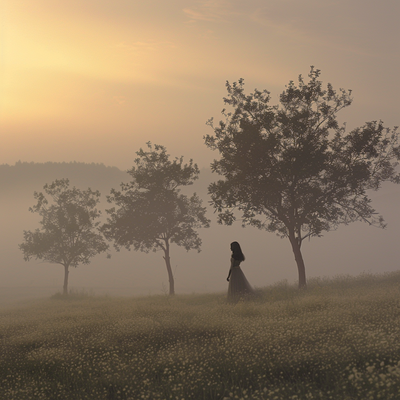
Under the moss-covered slimy woods of oak, behind the web-filled corners of departing twinkle, outside the false security of your wilderness refuge, she surrounds you like a dense fog in your gloomy mist.
She hums recklessly in your soul. Her words, thoughts, dreams and goals - they beg and they plead, furiously clawing to free their shackled roots.
You feel her sometimes, humming recklessly in your soul, beneath the static, behind the walls, beckoning you with waves of purpose and delight.
She is the one who refuses to die, the one whose voice trembles through the cracks in your ribcage when the world feels dark and airless. She is the one Clarissa Pinkola Estés wrote about: the wild, instinctive woman who survives droughts and winters and bone-deep heartbreak. The one who keeps rising from her own ashes like she’s been doing it for centuries (because she has).
She knows you better than you do. She loves you more than you do.
She sees what you can’t.
She's the real you. The chosen you. The anointed you. The “she is called mighty and limitless” you.
She holds the blueprint of the woman you’re still becoming.
And she wonders, sometimes aloud, sometimes in the quiet pulse beneath your skin, why you can’t see your own magnificence.
“Please see what I see,” she whispers.
“Please share voice and beauty with the world. We need you.”
But she doesn’t force you.
She waits. Always, she waits.
It's like the deeper, wilder intelligence that fashioned the twilight twinkles of your soul knows you will eventually come home.
So she waits, with patience and tenderness.
The truth is: some days I question if any of this is worth it.
The fight.
The pressure.
The depression.
The intense grief that doesn’t announce itself, it just arrives and plops its chunky self directly on the most weakened part of your heaving-in-tears chest.
Trauma researchers like van der Kolk say the body remembers what the mind tries to outrun, and I feel that truth in my bones. My knees wobble under the weight of memories I didn’t consent to carry. My spirit folds in on itself sometimes, asking questions with no answers, begging for a softness that hasn’t arrived yet.
How much longer must I keep walking through fire? How many times must I be rebuilt from rubble? When does the becoming stop hurting? How much more do I have to go through before I start seeing the light? How much more poking and prodding, heat and pressure can I take before I bow in surrendered defeat?
Some days I am so tired, so bone-weary, so emotionally threadbare that breathing feels like an act of rebellion. The overwhelm rolls in like a storm front, and suddenly I am small again - confused, aching, worn thin by life’s unrelenting lessons. It feels easier to disappear under a rock, talk to worms, or hide inside the earth with the snails.
And yet… there she is.
That other me.
That wiser me.
That ancient-remembering me.
The one Rilke gestured toward when he wrote about the “inner sky,” the part of us that expands even during despair. The one Pema Chödrön points to when she teaches that sitting with our pain—not outrunning it—is how we collapse the walls around our hearts.
She waits for me with the patience of a saint and the fierce tenderness of a wolf-mother. She sits quietly in the dark, glowing faintly, whispering truths I don’t feel ready for:
“Hey love, you’re still here. You haven’t disappeared. Your spirit may be cracked and trembling, but you’re still mighty. You’re still limitless. Not in a cliché way - limitless as in: even your breaking doesn’t get to kill your becoming.”
She doesn’t promise ease. She promises truth.
“You’ve survived every version of yourself so far,” she says. “You’re not the exception. You’re the evidence.”
And something deep inside me exhales.
Because she is right. She has always been right.
Pain has never been the end of me, not once. Every collapse has carried me closer to who I’m meant to become. Every heartbreak has cracked open a new doorway. Every trial has sharpened my instinct and strengthened the parts of me that refuse to bow.
So I listen.
I rise.
Not gracefully. Not confidently. But honestly.
And she rises with me.
It’s her - her fierce tenderness, her devotion, her unshaken belief in who I am becoming - that makes life worth living.
She’s alive.
I’m alive.
And when I forget my way, she guides me. Not with maps or certainty, but with a steady pull toward the horizon of who I’m meant to be.
“Just go,” she says.
“I’ll show you exactly where to go next."
No spam, no sharing to third party. Only you and me.
Member discussion